
Investment Dressing: Buy Less, Choose Better
There is a common misconception that investment dressing means filling your wardrobe with expensive clothes. It doesn't.
A high price tag doesn't guarantee great style, just as an affordable piece isn't automatically a poor purchase. The difference between an expensive wardrobe and a good wardrobe comes down to something much simpler: intention.
The best wardrobes are built gradually, around pieces that fit beautifully, work with the life you actually lead and can be worn in more than one way. They're anchored by quality staples and brought to life with colour, print and the occasional fashion-forward piece.
At Red Pearl, we've seen the proof hanging in our customers' wardrobes. Women regularly walk into the store wearing a coat, jacket or pair of trousers they bought from us five, six or even ten years ago.
That's investment dressing.
And it doesn't mean you have to stop enjoying fashion. Quite the opposite. When the foundations of your wardrobe are right, you have much more freedom to have fun with everything else.
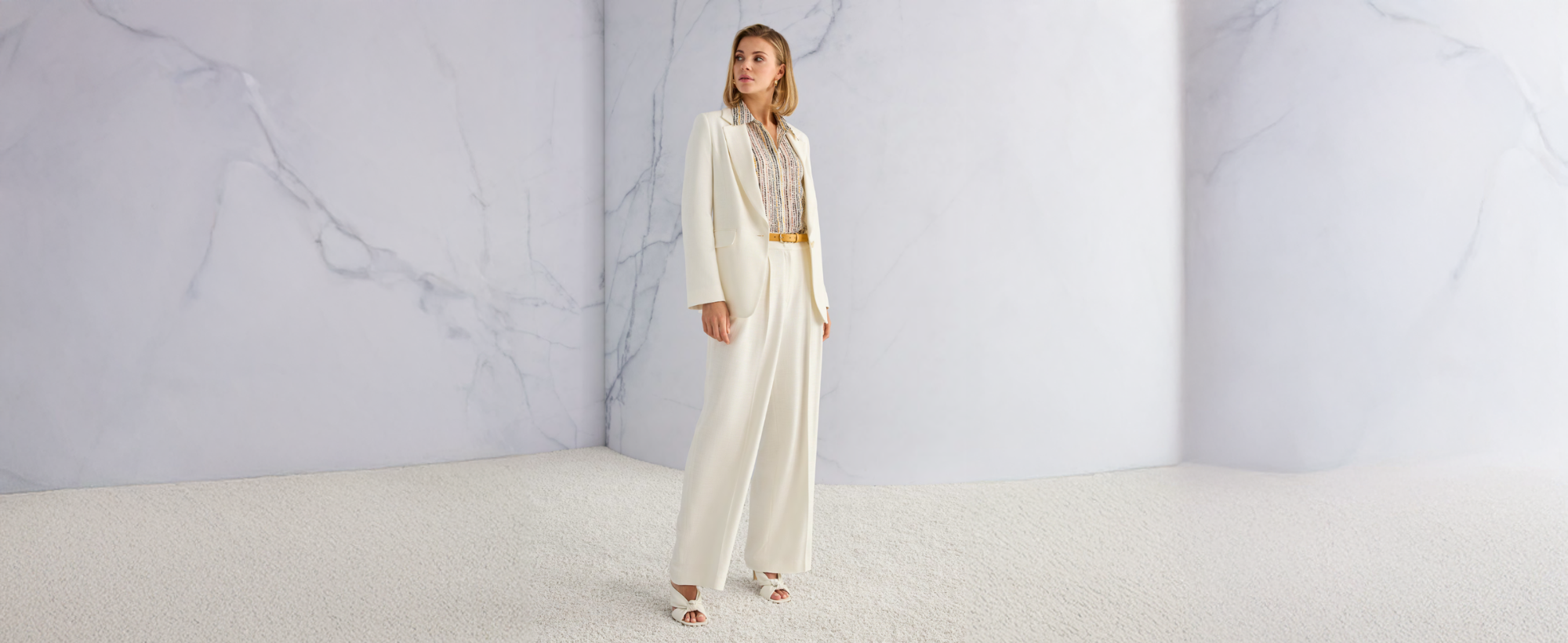
What is investment dressing?
Investment dressing is about buying fewer pieces, choosing them carefully and considering the value they'll provide long after you leave the shop.
For the foundations of your wardrobe, simplicity is often your friend. A beautifully cut pair of black trousers, great denim, white trousers, a well-made blazer, quality knitwear or an excellent winter coat can be worn again and again.
These are the pieces where spending a little more can make sense.
Once those foundations are there, seasonal fashion becomes the fun part. A beautiful print, an unexpected colour or a contemporary silhouette can breathe new life into pieces you've owned for years.
We like to think of it roughly as 70–80% enduring wardrobe and 20–30% fashion, colour and personality.
Because investment dressing shouldn't result in a wardrobe containing nothing but beige.
Price and value aren't the same thing
One of the biggest mistakes you can make when trying to "buy quality" is assuming spending more automatically guarantees a better purchase.
It doesn't.
Before looking at the label, look at the garment.
Consider the fabrication and construction. Look at the seams, lining, buttons and hardware. Feel the fabric against your skin. Look at how the garment hangs on your body and, perhaps most importantly, how you feel wearing it.
Natural fibres such as wool, silk and cotton can be wonderful, particularly when breathability matters, but don't dismiss a garment simply because its composition isn't 100% natural.
Modern fabric technology has come a long way. Carefully chosen viscose or synthetic fibres can sometimes improve shape retention, durability, stretch, washability and comfort. Quality is about how all the elements of a garment work together, rather than one impressive word on a composition label.
The same applies to where something is made. European manufacturing carries an understandable appeal, but country of origin alone doesn't determine quality. A good fashion house can work with an excellent specialist manufacturer elsewhere in the world and produce an exceptional garment.
Judge what you're actually wearing.
Where is it worth spending more?
Not every category in your wardrobe requires the same investment.
If we were helping someone allocate a wardrobe budget, we'd generally put more towards coats, jackets, trousers, denim, knitwear, dresses and good footwear, before spending heavily on simple T-shirts, tanks and highly seasonal pieces.
Why?
Because these are often the hardworking pieces.
A good coat can come out every winter for a decade. A beautifully cut jacket can transform jeans and a T-shirt. Great trousers might be worn several times a week. Quality denim becomes the foundation of countless outfits.
And then there's fit.
A beautifully made jacket has structure. A good pair of trousers sits properly through the waist, hip and leg. Great denim retains its shape. Quality knitwear feels good against your skin and should continue looking good after repeated wear.
Those differences become much more noticeable when you're living in the clothes rather than simply admiring them on a hanger.
Red Pearl pieces that prove the point
We see this philosophy play out with our customers all the time.
A Marc Cain coat or jacket might sit around the $800–$1,200 mark, but these are the pieces customers can pull out year after year. In fact, we've had customers return to Red Pearl wearing Marc Cain outerwear they bought many years earlier - still looking fantastic.
Raffaello Rossi trousers, at around $300, are another great example. They're comfortable, incredibly practical and make excellent travel companions. Certain styles can come straight out of a suitcase ready to wear, and we've had women discover a fit they love before returning for it in several colours.
MOS MOSH denim occupies a similar place in the everyday wardrobe. At around $300, you're paying for strong construction, considered washes and an extensive choice of fits. Find the right pair and suddenly half your wardrobe works with them.
A MOS MOSH blazer, around the $500 mark, combines contemporary shapes with great fit and some wonderfully playful linings. Many styles are also machine washable - a very practical consideration for something you intend to wear frequently.
And Ilse Jacobsen's raincoats and boots are the kind of functional pieces that demonstrate why design matters. The clean Danish aesthetic doesn't quickly date, while the construction is designed for something even more important: actually being worn.
That's where investment dressing starts to make financial sense.
Think in cost per wear, not simply cost
Imagine two purchases.
You buy a $700 jacket and wear it 100 times over several years. That's $7 per wear.
You impulse-buy a $150 top and wear it twice. That's $75 per wear.
Which was expensive?
It's one reason we sometimes see customers hesitate over a purchase, eventually take the plunge, and return months or years later telling us it was one of the best things they ever bought.
A genuine investment piece often becomes the item you don't think twice about wearing. It's the jacket you grab when you're running out the door. The trousers you pack for every trip. The jeans you reach for whenever you "have nothing to wear".
Its cost per wear keeps falling because it keeps earning its place.
Beware the false economy
Saving money at the checkout isn't particularly useful if you have to replace the garment six months later.
Cheap knitwear that pills almost immediately. Denim that bags at the knees. Trousers that lose their shape. Jackets that never quite sit properly. Summer clothes that leave you feeling hot and uncomfortable.
They're only bargains if you actually wear them.
An even bigger false economy is buying five pieces you quite like instead of the one piece you really wanted.
Those five compromises clutter the wardrobe while the item you actually loved remains in your head.
Sometimes buying less really does mean choosing better.
Comfort is part of quality
This gets overlooked surprisingly often.
You can buy the most beautifully constructed garment in the world, but if you spend the entire day pulling at it, adjusting it or wishing you could take it off, it's unlikely to become an investment piece.
So don't just stand in front of the fitting-room mirror.
Walk around. Sit down. Raise your arms. Put your hands in the pockets. Try the jacket buttoned and unbuttoned. See what happens to a pair of trousers when you sit.
At Red Pearl, we'll happily have a chat while you wander around the shop in something. In fact, we'd prefer you did.
The clothes you wear for years tend to be the ones you can actually live in.
Buy for your real life, not your imaginary one
Investment dressing is personal because value depends on lifestyle.
A beautiful dry-clean-only cocktail dress might be an excellent investment for a woman with a calendar full of events. For someone whose life revolves around travel and relaxed lunches, it might spend years untouched.
That's why some of the most useful questions we ask in-store aren't really about fashion:
Where are you going to wear it? What do you already own that works with it? Does it travel well? How will you wash it? Will you actually hand wash it?
If you travel frequently, crease resistance and packability may be worth paying for. If you need everyday clothes, washability becomes far more important. If you attend regular events, a beautifully made dress or jacket may justify a greater investment.
Buy for the woman you are rather than the woman your fantasy calendar says you're going to become.
Don't spend investment money on the wrong things
Knowing where not to invest is just as useful.
Be cautious about spending heavily on an extreme trend that you suspect you'll tire of next season. The same applies to a colour you rarely wear, something that requires care you know you'll never give it, or - most importantly - a garment that doesn't fit properly.
Don't buy an expensive piece hoping you'll somehow learn to love it.
And don't confuse an impressive discount with value.
Can sale fashion be an investment?
Absolutely.
In fact, sale can be one of the smartest ways to investment dress.
A timeless $1,000 winter coat reduced to $500 at the end of the season can be an excellent purchase if you know you'll pull it out next winter and for many winters after that.
The important thing is to reverse the usual sale-shopping question.
Don't ask:
"Is this 50% off?"
Ask:
"Would I still want this if it weren't 50% off?"
If the answer is no, you've probably found a bargain rather than an investment.
The Red Pearl Investment Test
Before committing to a significant wardrobe purchase, ask yourself:
- Does it fit beautifully? Not "will it fit when I lose a few kilos?" Not "it's almost right." Does it fit you now?
- Is it genuinely comfortable? Can you sit, walk and move freely?
- Can I wear it more than one way? Even better, can you immediately picture three outfits?
- Does it work with clothes I already own? A new purchase shouldn't necessarily require another three purchases before you can wear it.
- Does the quality justify the price? Look beyond the label to the fabric, construction, finish and functionality.
- Can I realistically care for it? Be truthful about your relationship with hand washing and dry cleaning.
- Would I want it if it weren't on sale? Discounts can distort judgement remarkably quickly.
- Do I genuinely love it? A sensible wardrobe doesn't need to be a joyless one.
If a piece passes those tests, there's a good chance you've found something that deserves a place in your wardrobe.
Investment dressing doesn't mean ignoring trends
We're certainly not suggesting you spend the rest of your life wearing the same black trousers.
Fashion should be fun.
A strong wardrobe simply gives you a foundation from which to experiment. You might introduce this season's colour through a knit, add a fabulous printed blouse to trousers you've owned for five years or try a new denim silhouette with your favourite jacket.
That balance is what keeps a wardrobe contemporary without requiring you to replace it every season.
Invest in the foundation. Play with the rest.
Choose Well. Wear Often. Love for Years.
Ultimately, the difference between an expensive wardrobe and a great wardrobe isn't the amount of money hanging inside it. It's how well those pieces work for you.
It's about fit, versatility, comfort, quality, longevity and, importantly, personality. The best investment pieces aren't necessarily defined by their price tags. They're the clothes that work with what you already own, suit the life you actually lead and become the pieces you instinctively reach for again and again.
Great style comes from understanding what works for your body, your wardrobe and your lifestyle — while still leaving plenty of room for colour, print and those irresistible pieces that simply make you feel fantastic.
A great wardrobe should continue to evolve with you. Invest in quality where it matters, introduce new pieces that bring fresh possibilities to old favourites, and don't be afraid to have a little fun along the way.
Because perhaps the best way to think about investment dressing is this:
Choose well. Wear often. Love for years.